
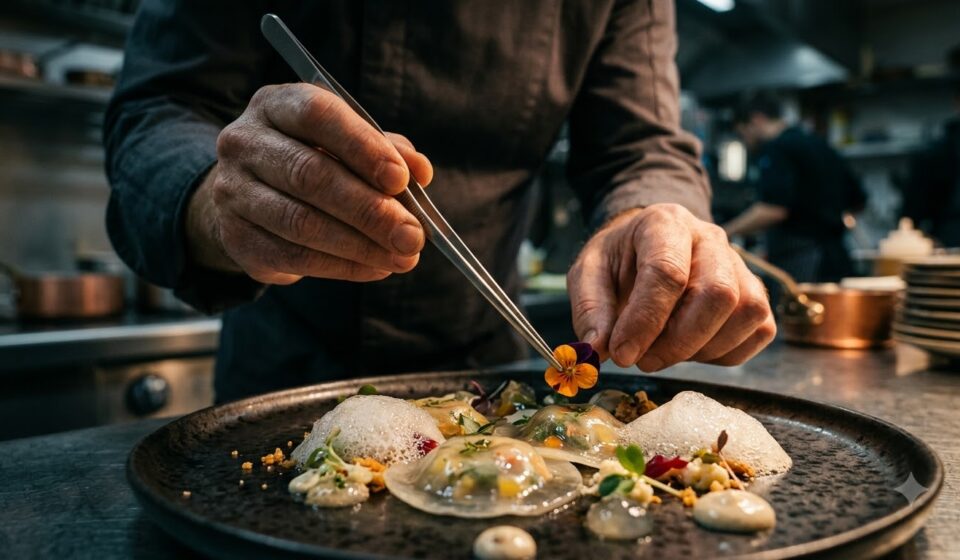

While San Sebastián often gets lauded as Spain’s culinary heartland and Madrid serves as its political and financial stomach, Barcelona is the country’s creative laboratory. Framed by the Mediterranean Sea and the Catalan Pyrenees, this vibrant metropolis has long been a incubator for artistic rebellion—from Antoni Gaudí’s surreal architecture to Joan Miró’s abstract canvases.
It should come as no surprise, then, that Barcelona’s avant-garde dining scene is an extension of this restless imagination. Following in the seismic footprint of molecular gastronomy pioneer El Bulli, contemporary Catalan chefs treat the plate as a canvas, fusing ancestral Mediterranean flavors with cutting-edge science, conceptual storytelling, and radical technique.
1. The Philosophy: Tradition Meets Alchemy
At the core of Barcelona’s modern gastronomic movement lies a fascinating paradox: deep reverence for Catalan culinary roots married to an absolute refusal to let tradition stay still. Chefs here do not merely replicate recipes passed down through generations; they deconstruct, analyze, and rebuild them.
- The Sea and the Mountain (Mar i Muntanya): Catalan cuisine famously juxtaposes seafood with meats. Avant-garde kitchens elevate this philosophy into conceptual art, pairing delicate coastal elements with intense forest-foraged flavors using textures and forms that defy expectations—think transparent ravioli, edible stones, or foams capturing the essence of pine and seawater.
- The Sensory Narrative: Dining at an avant-garde temple in Barcelona is rarely just a meal; it is a multi-act performance. Menus are designed as narrative journeys, guiding diners through memories of Catalan childhoods, coastal storms, or industrial evolution.
2. Pioneers and Modern Cathedrals
Barcelona and its surrounding countryside are home to some of the most influential dining rooms on the global stage, where boundaries are continually pushed.
- Disfrutar: Founded by former El Bulli chefs Oriol Castro, Eduard Xatruch, and Mateu Casañas, Disfrutar (“Enjoy”) is a masterclass in playful illusion and technical wizardry. Dishes like their famous multi-sphered liquid salads or postmodern takes on traditional classics deliver waves of shock and delight.
- Cocina Hermanos Torres: Housed in a stunning, industrial former tire workshop, twin chefs Sergio and Javier Torres have created an architectural marvel where the kitchen is the absolute center of the room. The multi-course experience blends theatrical openness with refined, hyper-seasonal haute cuisine.
- ABaC: Helmed by Jordi Cruz, this three-star sanctuary pairs luxurious surroundings with an avant-garde approach that constantly tinkers with temperatures, textures, and unexpected flavor harmonies.
3. The Anatomy of a Modern Tasting Menu
An avant-garde tasting menu in Barcelona is a carefully choreographed marathon of courses—often spanning 20 to 30 distinct bites.
- The Snack Symphony: Meals frequently begin away from the main dining table, standing in a kitchen or a private lounge with a rapid-fire sequence of finger foods designed to wake up the palate. You might encounter edible flowers filled with frozen gazpacho or crisps made from unexpected marine elements.
- The Trompe l’œil: A signature of the Barcelona school is visual deception. A dish that looks like a smooth pebble on a beach might reveal itself to be a savory foie gras bonbon encased in cocoa butter; a bowl of noodles might actually be translucent strips of squid.
- The Avant-Garde Sweet Transition: Dessert breaks traditional boundaries by blurring the line between savory and sweet, incorporating herbs, sea salt, fermented ingredients, and cold-smoke techniques to close the evening.
4. Navigating the Scene: Practical Tips for the Explorer
Experiencing Barcelona’s top-tier culinary laboratories requires preparation and an open mindset.
- Booking Windows: Because venues like Disfrutar or Hermanos Torres operate on global waiting lists, reservations often open months in advance (sometimes midnight on specific dates). Setting alerts is essential.
- Pacing the Experience: A full avant-garde tasting menu can easily last three to four hours. Approach the meal with curiosity rather than hunger alone—you are engaging with a work of performance art.
- Wine Pairing: Do not skip the wine pairing if offered. Catalan winemakers are experiencing a renaissance of their own, producing stunning biodynamic, natural, and low-intervention wines from historic volcanic soils (like Priorat and Penedès) that elevate the experimental dishes to new heights.
Final Thoughts for the Explorer
Barcelona’s avant-garde dining scene proves that food can challenge our perceptions, evoke deep nostalgia, and push the limits of human creativity. It invites the traveler not just to eat, but to participate in a living, breathing culinary evolution where every bite tells a story of an uncompromising city.