
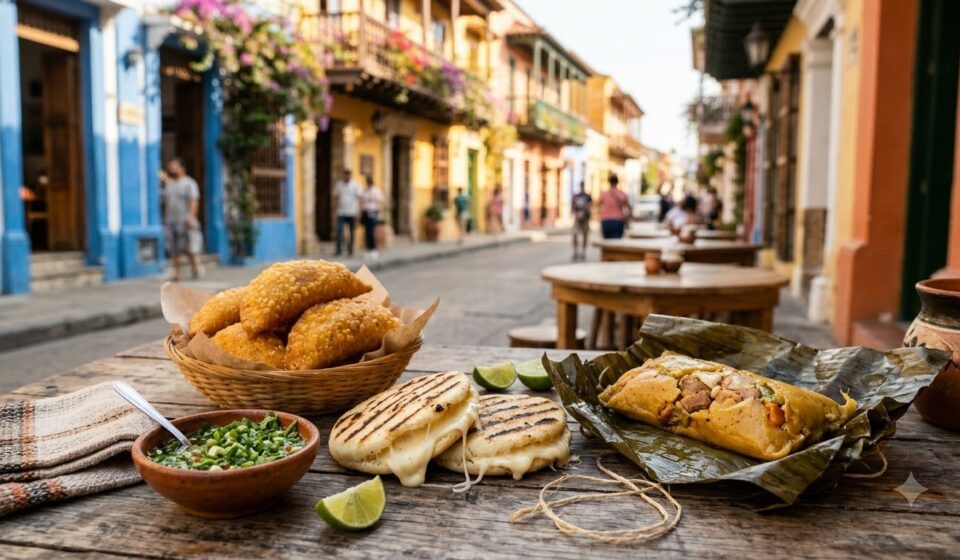

To travel through Colombia is to be in a constant, delicious dialogue with the street. From the brisk Andean air of Bogotá to the humid, sun-baked Caribbean breezes of Cartagena, the air is perfumed with the scent of toasted corn, sizzling plantains, and woodsmoke.
While Colombian fine dining is currently enjoying an exciting global renaissance, the true heartbeat of the country’s culinary identity lives on the corner. Here, humble street carts, open-air markets, and neighborhood tiendas serve up an ancient, corn-centric comfort food tradition. Whether you are grabbing a quick breakfast on the way to work or fueling up for a mountain hike, mastering Colombia’s holy trinity of corn-based street eats—arepas, empanadas, and tamales—is an essential traveler’s rite of passage.
1. The Arepa: The Versatile Canvas of Colombia
If bread is the staff of life in Europe, the arepa is its golden, griddled equivalent in Colombia. Made from ground maize dough or pre-cooked cornmeal (masarepa), arepas vary wildly across the country’s diverse regional topography, reflecting local climates and agricultural habits.
- Arepa Paisa (Antioquia): Thin, unsalted, and traditionally served blank. Think of it less as a sandwich and more as an edible utensil designed to scoop up hearty bean stews (frijoles) or act as a butter-soaked base for fried eggs and hogao (a savory tomato-onion soffritto).
- Arepa Boyacense (Boyacá): Thick, slightly sweet, and distinctively yellow, featuring a touch of sugar and milk kneaded into the dough. It is often wrapped around a core of local white cow’s milk cheese (queso campesino) and served piping hot straight off a clay griddle.
- Arepa de Huevo (Caribbean Coast): A magnificent street-food marvel. A corn dough pocket is deep-fried once to puff it up, carefully punctured to slip in a raw egg and seasoned ground meat, and then returned to the bubbling oil until the egg is perfectly poached inside its crunchy shell.
2. The Empanada: The Art of the Golden Crunch
While empanadas exist across Latin America, the Colombian version possesses a distinct personality defined by its wrapper and texture. Unlike the baked, pastry-like turnovers found in Argentina, Colombian empanadas are built on a base of yellow corn dough and fried to a deep, blistering golden crisp.
- The Filling Matrix: The classic Colombian empanada is stuffed with a savory, spiced mixture of shredded beef or chicken combined with boiled potatoes (papa criolla), seasoned with cumin, garlic, and fresh cilantro.
- The Golden Rule—Aji: An empanada is never eaten alone; it is always accompanied by a bottle of house-made ají or ají picante. This vibrant, watery salsa combines finely chopped green onions, cilantro, chili peppers, lime juice, and a splash of vinegar, cutting through the richness of the fried corn shell with a sharp, herbaceous kick.
3. The Tamale: A Regional Symphony Wrapped in Leaves
If arepas and empanadas are quick street-side bites, the tamale is a Sunday ritual. Found throughout Latin America, the Colombian tamale is distinguished by its sheer generosity, bundling multiple proteins, vegetables, and masa into a neat package tied with string and steamed inside plantain leaves.
- Tamal Tolimense (Tolima & Huila): Perhaps the most famous iteration. It features a base of yellow corn masa loaded with pork ribs, chicken, beef, hard-boiled eggs, carrots, peas, and potatoes—all marinated overnight in a rich red-pepper-and-cumin sauce before being slow-steamed for hours.
- Tamal Santafereño (Bogotá): A cooler-climate favorite traditionally eaten for breakfast with a cup of hot chocolate (often accompanied by a chunk of salty cheese dropped right into the mug). It swaps yellow corn for white maize and frequently includes garbanzo beans alongside pork and chicken.
4. Navigating the Corner Stalls: Practical Tips for the Explorer
Experiencing Colombia’s street food culture is delightfully informal, but a few local insights will help you navigate the bustling corners like a seasoned local.
- Follow the Lines: The best street stalls and areperas are measured by the crowd waiting around them. If a corner cart has a steady queue of locals waiting for their morning or late-afternoon snack, join the line immediately.
- Timing is Everything: Many iconic street vendors operate in distinct windows—early morning (6:00 AM to 10:00 AM) for fresh arepas and tamales, and late afternoon (4:00 PM to 7:00 PM) for hot-out-of-the-fryer empanadas.
- Embrace the Condiments: Do not shy away from the squeeze bottles on the counter. Beyond aji, you will frequently find hogao or house-made avocado sauces that elevate a simple street snack into a culinary masterpiece.
Final Thoughts for the Explorer
To eat from a Colombian street cart is to understand the warmth and resilience of its people. These recipes have been passed down through generations, surviving economic shifts and regional divides. Approach every corner with an open appetite, a handful of small bills, and a readiness to experience the soul of Colombia one crispy, corn-wrapped bite at a time.