
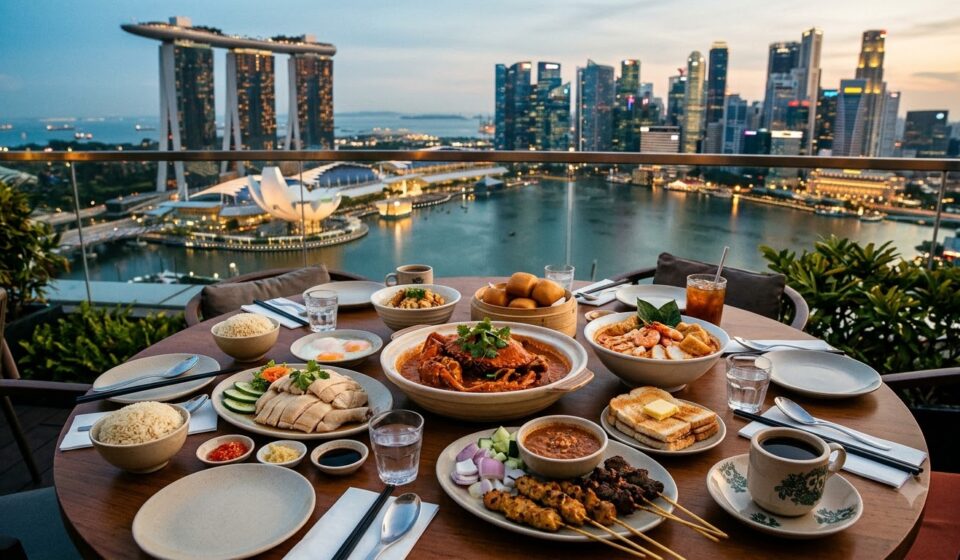

In Singapore, “Have you eaten?” is one of the most common ways to say hello. Food is how people here show affection and mark celebrations, and for many people it is the main shared language in a country of Chinese, Malay, Indian, Eurasian and Peranakan communities. On a 730-square-kilometre island, a plate of food can say a great deal about history, migration, class and pride.
The best way to understand Singapore’s food is to follow the range of it. At one end is a S$4 plate of chicken rice, eaten under a ceiling fan at a plastic table. At the other is a multi-course tasting menu in a hushed dining room overlooking Marina Bay. This article takes you from one end to the other, and shows why the two are more closely related than they look.
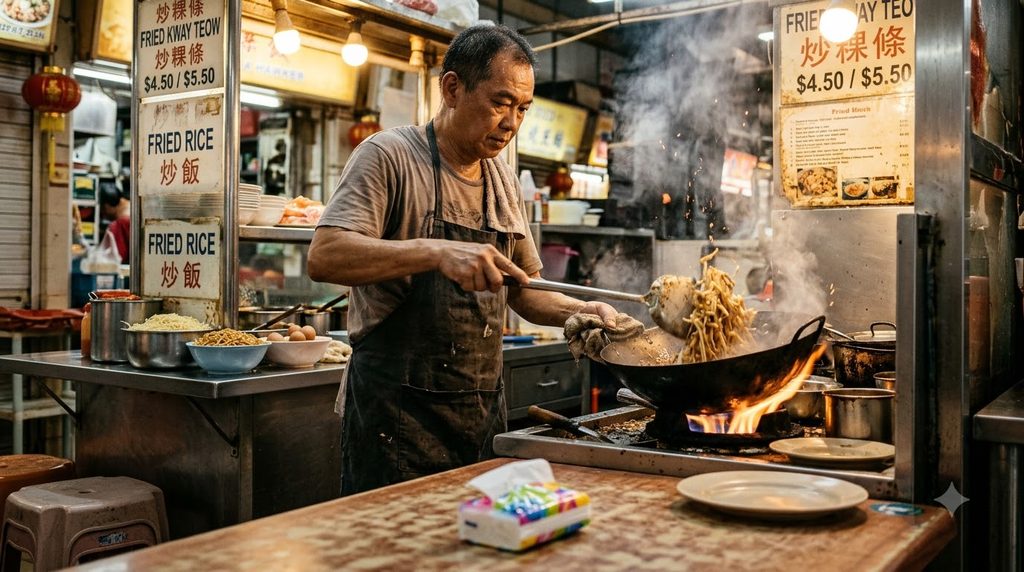
Part One: The Hawker Centre, Singapore’s Living Room
How the stalls came indoors
Before independence, street vendors sold food from carts and baskets on roadsides across the island. Their food was delicious but hard to regulate, and the sanitation and congestion problems were serious. From the 1970s onward, the government moved vendors into purpose-built hawker centres with running water, proper drainage and licensed stalls. It began as urban planning and public health policy. It also ended up preserving a food culture that might otherwise have been priced out of existence.
Today there are well over a hundred hawker centres across the island, in housing estates, business districts and tourist areas. In December 2020, UNESCO inscribed Singapore’s hawker culture on its list of Intangible Cultural Heritage of Humanity. The recognition was for the whole social institution: the communal tables, the way neighbours and strangers share a space, and the craft passed from one generation of cooks to the next.
Reading a hawker centre
A first visit can be bewildering. You will see dozens of stalls, many queues, handwritten signs and a lot of unspoken etiquette. A few things help:
- Follow the queue. A long line at an unremarkable stall usually means something. Locals will wait 30 minutes or more for a plate they love.
- “Chope” your seat. Placing a packet of tissues on a table reserves it while you queue. Singaporeans do this reliably and without discussion.
- Specialise. Most stalls cook one dish, or a small family of dishes, and they have often cooked it for decades. This focus is why the quality is so high.
- Return your tray. In recent years, returning trays and crockery has become the expected norm.
The essential dishes
Hainanese chicken rice. This is the unofficial national dish. Chicken is poached gently and then shocked in ice water, which gives it silky skin and tender, juicy meat. The rice is cooked in chicken stock with ginger, garlic and pandan, and it is often the real test of a stall. It comes with chilli sauce, ginger paste and dark soy. The dish traces back to Hainanese migrants, and in Singapore it has become something distinctly its own.
Laksa. This is a bowl of rice noodles in a rich, spicy coconut-milk broth, usually topped with prawns, cockles and fishcake. The Katong-style version is famous for noodles cut short enough to eat with just a spoon. It reflects the Peranakan tradition, which blends Chinese and Malay influences.
Char kway teow. Flat rice noodles are stir-fried over fierce heat with egg, Chinese sausage, cockles and bean sprouts. The prized quality is wok hei, the smoky “breath of the wok” that only a seasoned wok and a skilled cook can produce.
Nasi lemak. Rice cooked in coconut milk is served with fried anchovies, peanuts, cucumber, egg and sambal, often with fried chicken or fish. It is a Malay breakfast staple that is eaten at every hour of the day.
Bak kut teh. The name means “meat bone tea,” but it is a pork rib soup. The Teochew style is clear and peppery, and the Hokkien style is darker and herbal. It is typically eaten with rice, fried dough fritters and plenty of tea.
Satay. Skewered, marinated meat is grilled over charcoal and served with peanut sauce, rice cakes and cucumber. Evening satay streets are a long-standing tradition.
Roti prata. This is a flaky, crisp, griddled flatbread served with curry. It is a legacy of the Indian community, and the stretching and flipping of the dough is a show in its own right.
Hokkien mee, rojak, carrot cake and more. The list goes on: prawn-stock-laced noodles, a sweet-sour-spicy fruit and fritter salad, and the savoury “carrot cake” made from radish and rice flour, served either white or black with sweet dark soy.
Sweet endings and the kopi ritual
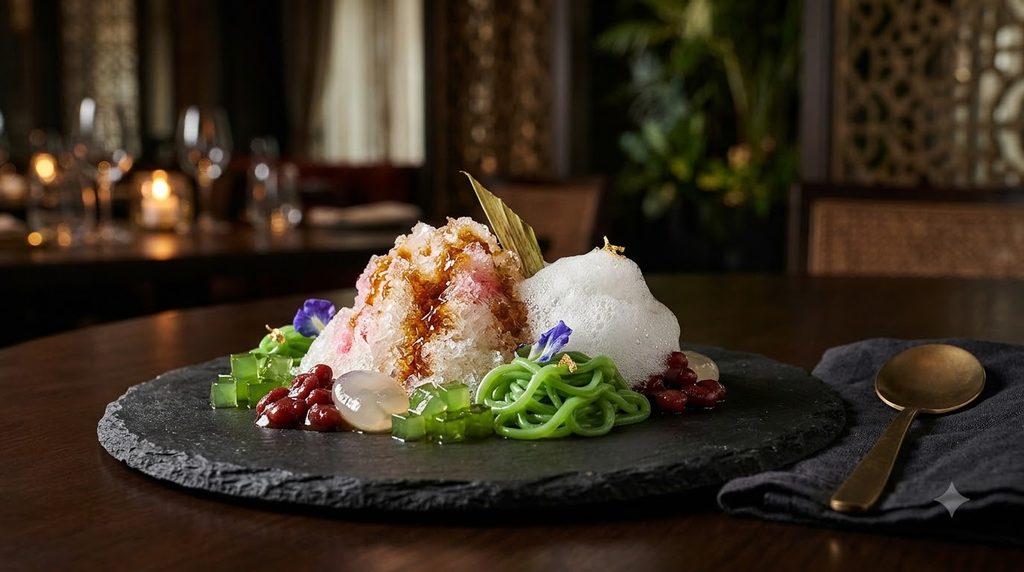
Dessert at a hawker centre might be ice kachang (shaved ice with syrup, beans and jelly), chendol (coconut milk, green jelly and palm sugar) or a plate of fresh fruit. The morning ritual, meanwhile, is kopi and kaya toast. Charcoal-grilled bread is spread with coconut jam and butter and served with soft-boiled eggs seasoned with soy sauce and white pepper.
Ordering kopi has its own vocabulary:
| Order | What you get |
|---|---|
| Kopi | Coffee with condensed milk |
| Kopi O | Black coffee with sugar |
| Kopi C | Coffee with evaporated milk |
| Kopi Peng | Iced coffee with condensed milk |
| Kopi Gao | Strong coffee |
| Kopi Siew Dai | Less sweet |
Knowing a few of these terms will mark you out immediately as someone who has done their homework.
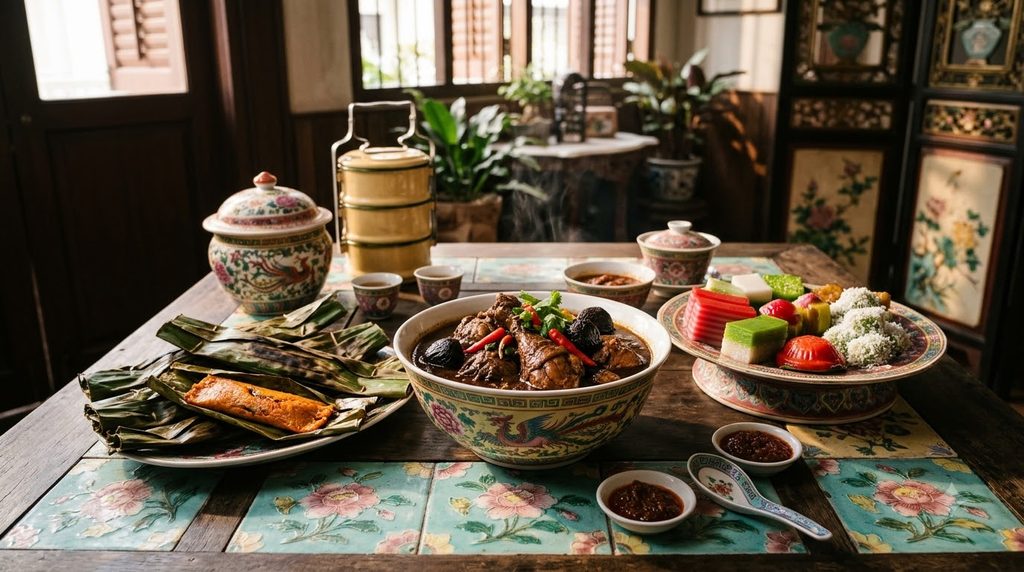
Part Two: The Middle Ground, Where Tradition Gets Comfortable
Between the hawker centre and the tasting menu sits a large and delicious middle: coffee shops (kopitiams), family-run restaurants, zi char kitchens and heritage eateries.
Zi char: home cooking at scale
Zi char means “cook and fry.” These casual restaurants serve large menus designed for sharing: salted egg yolk prawns, sweet-and-sour pork, claypot tofu, stir-fried greens and whole steamed fish. A family dinner here is a Singaporean rite of passage.
Chilli crab and the seafood tradition
Chilli crab, with its thick, sweet-savoury-spicy tomato and egg sauce, is the dish most often associated with festive dining. A couple of seafood restaurants have long claimed to have originated it, and a pairing of fried mantou buns for mopping up the sauce is considered essential. Black pepper crab is the drier, punchier alternative. Eating either one is gloriously messy, and nobody leaves with clean hands.
Peranakan and Eurasian kitchens
Peranakan cuisine, also called Nyonya, comes from the descendants of early Chinese settlers who intermarried with local Malays. It is labour-intensive, aromatic and layered: ayam buah keluak (chicken stewed with a distinctive black nut), babi pongteh, otak-otak and sweet kueh in jewel colours. Eurasian cuisine, with dishes like devil’s curry, reflects Portuguese, Dutch and British ties and is a smaller but treasured part of the picture.
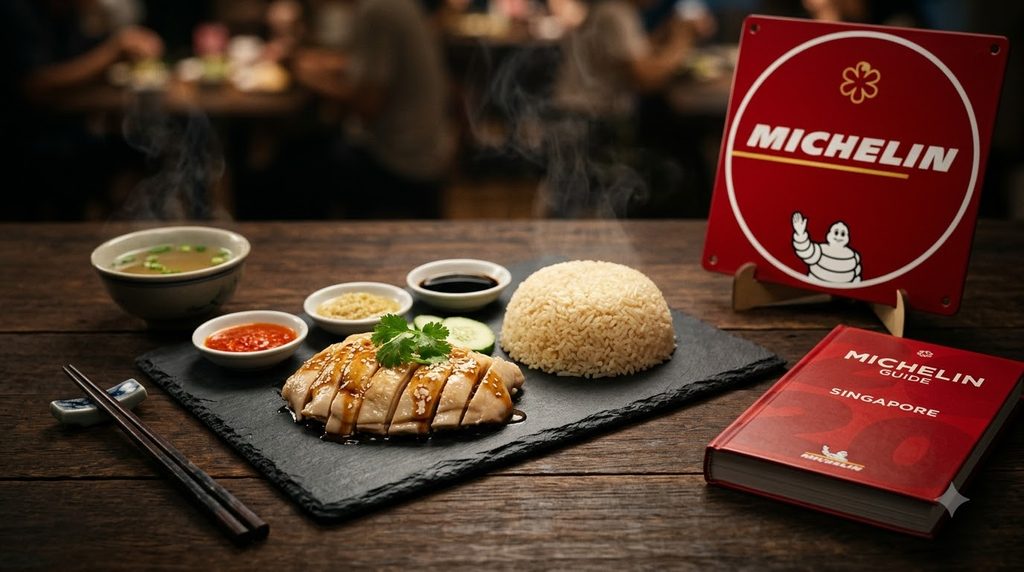
Part Three: The Michelin Moment
In 2016, the Michelin Guide arrived in Singapore, and it changed the conversation. The guide gave starred recognition to street food, awarding a star to a hawker stall for the first time. This drew worldwide attention to the idea that a S$2 to S$6 bowl could be taken as seriously as a restaurant meal costing a hundred times more.
The guide’s Bib Gourmand category, which recognises good food at moderate prices, has since become a map of the city’s best-value eating. Whether stalls and restaurants welcome the attention or not, many have seen longer queues as a result, along with both pride and pressure.
Part Four: Fine Dining, Singapore Style
A globally ambitious dining scene
Singapore’s fine dining sector punches well above its size. Because the city is a regional hub, it attracts chefs from France, Japan, Australia and beyond. At the same time, a generation of local chefs has started asking what Singaporean ingredients and memories look like on a tasting menu.
A few of the approaches worth knowing:
- Classical and contemporary French. Restaurants such as Odette and Les Amis have long been fixtures at the top of the city’s dining scene, showing precision, refined technique and polished service.
- Japanese omakase and kaiseki. Singapore has deep ties to Japanese cuisine, and chefs often fly in seafood and produce at the height of season.
- Live-fire and modern barbecue. Burnt Ends, with its Australian-influenced, wood-fired approach, shows the more casual and energetic side of high-end dining.
- Peranakan fine dining. Candlenut was the first Peranakan restaurant to earn a Michelin star, showing that heritage cooking can be refined without losing its soul.
- Modern Asian and Singaporean. Newer restaurants treat local flavours as a serious creative base, reinterpreting familiar dishes with new technique, local produce and personal memory.
What a “Singapore tasting menu” might look like
A thoughtful Singaporean tasting menu may borrow hawker flavours without simply copying the dishes. You might see:
- A chicken-rice-inspired course, with rice cooked in a rich stock and a delicate poached bird.
- A laksa reduction transformed into a bisque or sauce.
- Chilli crab flavours reworked with the crab served in a lighter, cleaner way.
- A dessert inspired by chendol or ice kachang, with the same flavours in more refined textures.
The test of such a dish is whether it respects the memory of the original. The best versions will make a Singaporean diner feel something familiar and new at the same time.
Part Five: What Connects the Plates
The same values at every price
The stall and the tasting room can look like different worlds, but they often share the same values:
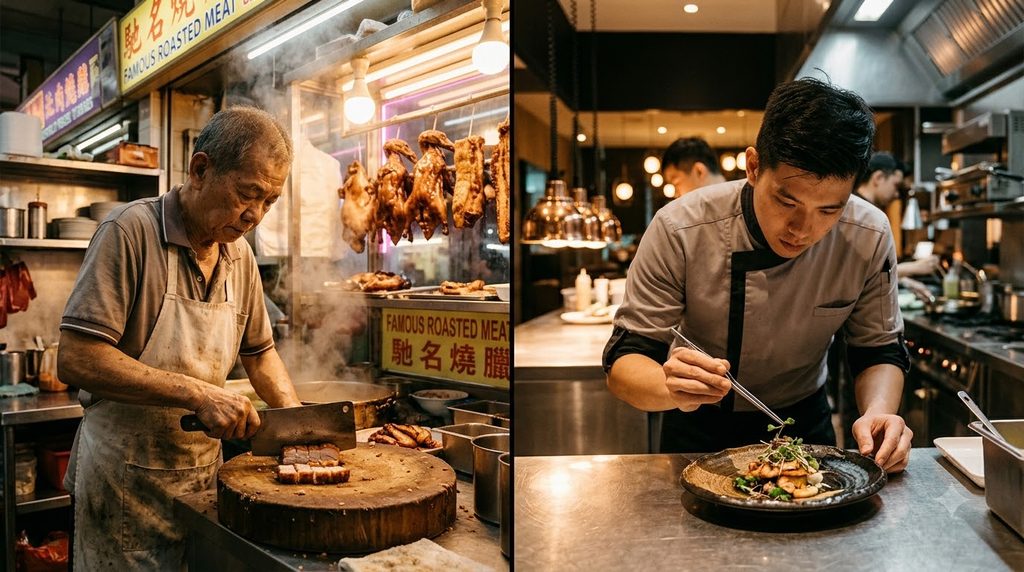
- Obsession with a single craft. A hawker spends decades on one dish, and a great chef refines a small number of ideas to near perfection.
- Respect for ingredients and technique. Whether it’s the temperature of poached chicken or the timing of a sauce, small details matter.
- Memory and identity. Both ends of the spectrum are trying to capture what a dish means to the people who grew up with it.
- Hospitality. The warmth of an auntie who remembers your order is a close cousin to the attentive service of a high-end dining room.
The challenges ahead
This food culture is not guaranteed to survive. The hawker trade is physically demanding, with long hours, heat and thin margins, and many experienced hawkers are ageing without obvious successors. Rising costs for ingredients and rent, and the difficulty of persuading younger people to take up the work, are real concerns. Programmes encouraging new hawkers, and a growing number of young cooks taking over family recipes or starting their own stalls, offer some hope. Diners also play a role. Eating at hawker centres regularly, and paying what the food is truly worth, helps keep them alive.
Practical Tips for Eating Your Way Through Singapore
- Go at off-peak times. Lunch rushes are intense. Arriving a little before noon, or after 1:30 pm, gives you shorter lines and more choice of seats.
- Bring cash and small change, although many stalls now accept digital payments such as PayNow.
- Go with friends. Sharing lets you taste more dishes in one sitting.
- Be open about spice. Many stalls will adjust the chilli if you ask.
- Mix the high and low. A good itinerary pairs a hawker breakfast, a zi char dinner and one special-occasion meal. Book fine dining well in advance, since popular restaurants fill up quickly.
- Check current details. Opening hours, prices, stall locations and Michelin listings change, so confirm before you travel.
Conclusion: One Plate at a Time
Singapore’s food story is not really about a ladder with hawker stalls at the bottom and fine dining at the top. It is a continuous conversation. The tasting menu draws on the memory of the street, and the hawker stall carries a craft as exacting as any professional kitchen. Both depend on people who care intensely about getting one thing right.
If you eat your way through the city with curiosity, you will find that a S$5 plate and a S$300 menu are doing the same fundamental work: telling you who Singapore is, and where it has come from. So pick a queue, take a seat, and start with whatever is in front of you.
If you’d like, I can turn this into a shareable doc, shorten it into a blog-length version, add a suggested 3-day food itinerary, or adapt the tone for a magazine, a travel blog or social media.