
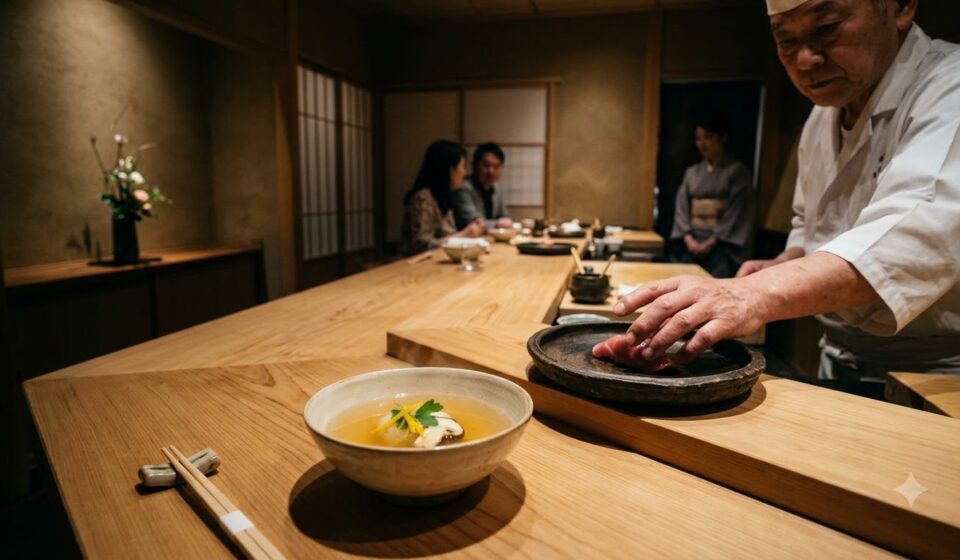

Tokyo holds a unique, almost mythical status in the global culinary landscape. For years, the Japanese capital has routinely boasted more Michelin three-star restaurants than Paris, transforming fine dining from a mere meal into a pilgrimage.
To cross the threshold of a Tokyo three-star establishment is to enter a temple of total dedication. These spaces are defined not by flash or extravagance, but by quiet reverence, obsessive craftsmanship (shokunin spirit), and an unyielding commitment to seasonal harmony. Whether structured around the multi-course artistry of traditional kaiseki, the minimalist perfection of Edomae sushi, or French technique re-engineered through Japanese sensibilities, a multi-course journey here is an exercise in pure mindfulness.
1. The Anatomy of a Masterpiece: The Kaiseki Experience
At temples of traditional Japanese cuisine like Kagurazaka Ishikawa or Kanda, a multi-course meal is designed to reflect the poetry of the changing seasons. Rooted in the traditions of the tea ceremony, a multi-course kaiseki journey is a carefully orchestrated progression of tastes, textures, and temperatures.
- Sakizuke (The Appetizer): Much like an overture in a symphony, the opening bite sets the seasonal tone. It might be a delicate pairing of sea urchin with freshly grated mountain yam, served in handcrafted ceramic glassware that echoes the coolness of early spring or the crispness of autumn.
- Wanmono (The Soup Course): Often considered the heart of a kaiseki meal, this clear dashi broth showcases the chef’s foundational skill. Made from meticulously aged-kombu and freshly shaved bonito flakes, the broth is profound in its clarity yet rich in umami, typically cradling a single seasonal morsel like pike conger or snow crab.
- Yakimono (The Grilled Course): Direct fire brings out rich, savory dimensions, frequently featuring local fish like sweetfish (ayu) grilled over binchotan charcoal with a crisp, salted skin and tender, smoky flesh.
2. The Sacred Geometry of Edomae Sushi
In Tokyo’s three-star sushi shrines, the multi-course journey shifts from a sprawling seasonal landscape to an intimate, hyper-focused dialogue between diner, chef, and single cuts of fish.
Though venues like Sushi Saito or Harutaka operate on an intimate scale—often limited to fewer than ten counter seats carved from single pieces of Hinoki cypress—the progression is masterfully paced.
- The Omakase Arc: The meal typically begins with several small plates (otsumami) of pristine sashimi and lightly cooked delicacies, preparing the palate before transitioning exclusively to nigiri.
- The Rice and Temperature Factor: The true mark of a master is the sushi rice (shari). Seasoned precisely with red or white vinegar and served at body temperature, each grain separates perfectly the moment it touches the tongue, balancing the rich, melting fats of bluefin tuna (otoro) or glistening gizzard shad (kohada).
3. Beyond Borders: Tokyo’s Global Three-Star Sanctuaries
Tokyo’s culinary temples are not restricted to traditional Japanese cuisine. The city has embraced foreign techniques and elevated them to staggering heights, creating distinct multi-course dialogues between East and West.
- French Precision with Japanese Soul:Institutions like Quintessence or Sézanne take classic French gastronomy and filter it through Japan’s hyper-seasonal bounty. A course might feature slow-roasted goat milk bavarois paired with Lily bulb and Hawaiian sea salt—a dish deceptively simple in appearance yet staggering in depth.
- Szenka and Cross-Cultural Mastery: Venues bridging regional boundaries, such as Sazenka, merge rigorous Chinese culinary heritage with Japanese hospitality (omotenashi) and localized ingredients, redefining what a multi-course tasting menu can achieve.
4. Navigating the Temples: Etiquette and Anticipation
Securing a seat at one of Tokyo’s culinary summits requires as much strategy as appreciation. Because many of these establishments operate with tiny dining rooms and strict reservation windows—often mediated exclusively through luxury hotel concierges or private networks—planning months in advance is standard.
Once inside, the atmosphere is hushed and respectful. Flash photography is frequently discouraged to preserve the serenity of the room, and guests are invited to experience each dish at the moment it is served, engaging all five senses in a fleeting, irreplaceable moment of artistic expression.
Final Reflections
A multi-course meal at a Tokyo three-star temple is more than dinner; it is an immersion into a culture of relentless pursuit. It reminds travelers that food can be an art form, a historical archive, and a profound act of hospitality all at once.