


















































For centuries, Samarkand existed in travelers’ imaginations as a near-mythical place — a city of turquoise domes, bustling caravan markets, and ancient scholars standing at the crossroads of the world. Once one of the greatest centers along the Silk Road, Samarkand connected China, Persia, India, and Europe through trade, science, culture, and ideas.
Today, this legendary city is experiencing a remarkable revival.
As travelers increasingly search for destinations beyond overcrowded tourist capitals, Samarkand has quietly emerged as one of the world’s most exciting cultural escapes. Rich history, stunning Islamic architecture, affordable luxury, expanding tourism infrastructure, and a growing global curiosity about Central Asia are turning Uzbekistan into one of the most talked-about travel destinations of 2026.
And at the center of it all stands Samarkand — ancient, beautiful, and finally receiving the attention it deserves.
The Ancient City That Once Ruled the Silk Road
Samarkand is not simply old. It is one of the oldest continuously inhabited cities on Earth.
Founded more than 2,700 years ago, the city has witnessed the rise and fall of empires, invasions, scientific revolutions, and global trade networks. Alexander the Great conquered it. Persian rulers shaped it. Mongols destroyed parts of it. Then the mighty conqueror Timur — known in the West as Tamerlane — transformed Samarkand into the glittering capital of his empire in the 14th century.
Under Timur, artisans, architects, astronomers, poets, and scholars were brought from across Asia and the Middle East to create one of the most magnificent cities in the Islamic world.
The result still feels breathtaking today.
Unlike many historic cities where only fragments remain, Samarkand still possesses extraordinary monuments that dominate the skyline with vivid blue mosaics, geometric tilework, towering minarets, and massive domes.
Walking through the city feels like entering a forgotten empire.
Registan Square: One of the Greatest Public Spaces on Earth
Every great city has a defining landmark:
- Paris has the Eiffel Tower
- Rome has the Colosseum
- Istanbul has Hagia Sophia
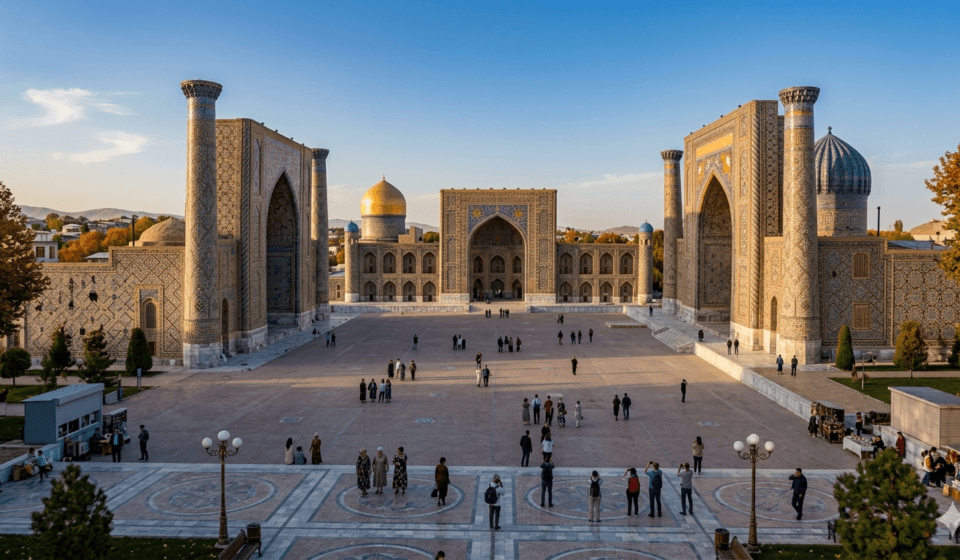
Samarkand has Registan Square.
Few places in the world create such instant awe.
The square is surrounded by three enormous madrasas covered in intricate mosaics and glazed ceramic tiles glowing in shades of turquoise, cobalt, and gold. These structures once served as elite Islamic schools where mathematics, astronomy, philosophy, and theology were studied centuries before many European universities flourished.
At sunrise, the square feels peaceful and almost spiritual. By evening, warm lights illuminate the giant facades, creating one of the most spectacular nighttime scenes in Central Asia.
Many travelers compare their first glimpse of Registan to seeing Petra or Machu Picchu for the first time. Photographs simply fail to capture its scale and detail.
What makes Registan especially remarkable is the atmosphere. Despite its historical significance, it still feels authentic rather than over-commercialized. You won’t find the overwhelming crowds seen at many global landmarks.
For travelers seeking grandeur without overtourism, Samarkand offers a rare balance.
Why 2026 Is the Perfect Time to Visit Uzbekistan
Several major changes are making Uzbekistan dramatically more accessible to international travelers.
Over the past few years, the Uzbek government has heavily invested in tourism infrastructure. Visa policies have become easier for many nationalities, high-speed rail networks now connect major cities efficiently, and international flight connections continue expanding.
Samarkand especially benefits from this modernization.
The city now blends ancient history with improving comfort:
- Boutique hotels inside restored historic mansions
- Modern cafés beside centuries-old monuments
- Better English-language tourism services
- Upgraded airports and train stations
- Growing luxury hospitality options
At the same time, Samarkand still feels undiscovered compared to destinations like Istanbul, Marrakech, or Cairo.
That balance may not last forever.
As social media, travel documentaries, and Central Asia-focused tourism continue growing, many travel experts believe Uzbekistan is approaching a major tourism boom. Visiting in 2026 offers the chance to experience Samarkand before mass tourism changes its character significantly.
The Architecture Feels Almost Unreal
Samarkand’s architecture is so visually striking that many first-time visitors genuinely feel shocked upon arrival.
The city’s monuments showcase Timurid architecture at its peak — a style famous for:
- Massive geometric patterns
- Brilliant blue tilework
- Symmetrical courtyards
- Monumental domes
- Arabic calligraphy
- Complex mosaic craftsmanship
One of the city’s most extraordinary sites is Shah-i-Zinda, a stunning avenue of mausoleums often called the most beautiful necropolis in the Islamic world.
Walking through Shah-i-Zinda feels surreal. Every surface appears covered in dazzling tilework. Shades of blue shift constantly depending on the sunlight, creating an almost dreamlike atmosphere.
Another essential landmark is Gur-e-Amir, the mausoleum of Timur himself. Its ribbed turquoise dome became an architectural inspiration for later monuments, including the Taj Mahal.
Even travelers who normally prioritize nature or food over history often find themselves captivated by Samarkand’s visual beauty.
The city doesn’t merely preserve history — it overwhelms you with it.
A Destination for Food Lovers
Central Asian cuisine remains surprisingly underrated internationally, and Samarkand is one of the best places to experience it.
Uzbek food reflects centuries of Silk Road influence, blending Persian, Turkish, Russian, Chinese, and nomadic traditions into hearty, flavorful dishes.
The national dish, plov, is a must-try. Made with rice, lamb, carrots, onions, and spices cooked slowly in giant metal cauldrons, plov is deeply tied to Uzbek identity and hospitality.
Samarkand’s version is particularly famous.
Other local specialties include:
- Samsa (oven-baked pastries filled with meat)
- Lagman noodles
- Shashlik skewers
- Fresh naan bread
- Manti dumplings
One of the city’s most memorable experiences is visiting a traditional bread market. Uzbek bread is treated with enormous cultural respect, and bakers still use centuries-old techniques in clay ovens.
Tea culture also plays an important role. Green tea is served constantly, often alongside dried fruits, nuts, and sweets.
Unlike expensive dining capitals elsewhere, Samarkand remains very affordable. Travelers can enjoy large traditional meals for a fraction of prices found in Western Europe or the Gulf.
The Silk Road Atmosphere Still Exists
Many historic cities lose their authenticity once tourism dominates daily life.
Samarkand still feels genuinely lived in.
At Siab Bazaar, traders sell spices, nuts, fruit, textiles, and bread much as merchants did centuries ago. The market is noisy, colorful, and deeply atmospheric.
You’ll hear Uzbek, Russian, Tajik, and other languages blending together — reminders that Samarkand has always been multicultural.
Away from the major monuments, ordinary life unfolds slowly:
- Elderly men playing chess in courtyards
- Families gathering for tea
- Children walking beneath ancient walls
- Small workshops producing handmade crafts
This living Silk Road atmosphere is part of what makes Samarkand special.
It doesn’t feel staged for tourists.
Luxury Without the Extreme Price Tag
Another reason Samarkand is attracting attention in 2026 is value.
Travelers increasingly seek destinations offering meaningful luxury experiences without the excessive prices of Paris, Dubai, or Santorini.
In Samarkand, visitors can stay in beautifully restored boutique hotels featuring:
- Traditional courtyards
- Handcrafted woodwork
- Silk textiles
- Rooftop terraces
- Historic architecture
High-end experiences remain surprisingly affordable compared to many global tourism hotspots.
Private guides, elegant hotels, and exceptional meals often cost far less than travelers expect.
This affordability allows visitors to experience cultural richness and comfort simultaneously.
Beyond Samarkand: Exploring Uzbekistan Further
While Samarkand may be the star attraction, it also serves as the perfect gateway to broader Uzbek adventures.
Travelers can easily continue to:
- Bukhara — a beautifully preserved medieval city
- Khiva — a walled desert city resembling an open-air museum
- Tashkent — the country’s modern capital
Thanks to Uzbekistan’s improving rail system, traveling between these cities is easier than ever.
Together, they create one of the world’s most underrated cultural travel routes.
The Emotional Power of Samarkand
Perhaps the most surprising thing about Samarkand is not just its beauty — but the emotional reaction it creates.
Many destinations impress visitors visually but feel detached from daily life. Samarkand feels different.
The city carries a sense of historical gravity. Standing beneath massive blue domes built centuries ago, travelers often feel connected to something larger than themselves — a reminder of how civilizations exchanged knowledge, art, science, and culture long before the modern world existed.
There’s also a feeling of discovery.
In an era when many famous destinations feel endlessly photographed and familiar before arrival, Samarkand still feels fresh to many travelers. The city surprises people.
That rarity has become incredibly valuable in modern travel.
Why Samarkand May Become One of the World’s Biggest Travel Stories
Samarkand represents several major travel trends converging at once:
- Interest in lesser-known destinations
- Demand for authentic cultural experiences
- Desire to avoid overtourism
- Affordable luxury travel
- Growing curiosity about Central Asia
- Increased flight connectivity
For years, destinations like Japan, Italy, and Thailand dominated international travel conversations. But many travelers now seek places that feel more original and less saturated.
Samarkand answers that desire perfectly.
It offers world-class architecture, fascinating history, incredible food, warm hospitality, and a sense of wonder still missing from many overexposed destinations.
And unlike heavily commercialized tourist cities, Samarkand still feels like a place travelers are discovering rather than simply consuming.
That may be exactly why 2026 is shaping up to be the year the world finally rediscovers this Silk Road masterpiece.