














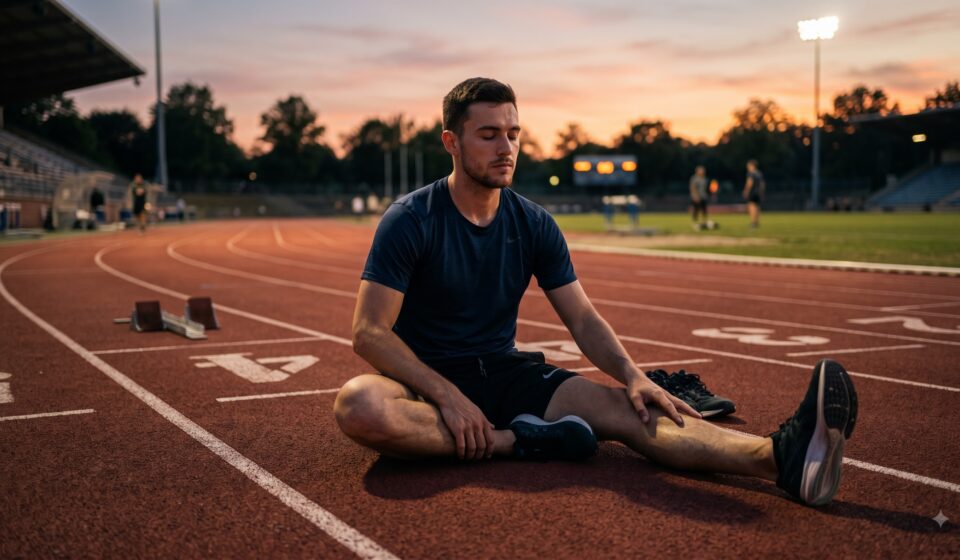

There’s no single secret ritual that unites every Olympic champion — athletes are far too different in sport, personality, and culture for that. But sports psychologists who’ve worked with elite competitors, and the recurring patterns across countless athlete interviews and memoirs, point to a surprisingly consistent set of principles for the night before the biggest performance of an athlete’s life. It’s less about a magic routine and more about a disciplined approach to managing the mind and body when the stakes are highest.
1. The Routine Is Already Decided — Nothing New Gets Tried
Perhaps the most universal principle: the night before competition is not the time for experimentation. No new stretching technique, no new meal, no new pre-sleep routine. Elite athletes typically rely on a routine rehearsed dozens or hundreds of times in training, because familiarity itself is calming. A predictable sequence of actions — the same meal timing, the same gear check, the same wind-down — signals to the brain that this is a known, manageable situation rather than a threat.
This is why athletes often talk about treating the Olympic final “like any other competition.” It’s not that they don’t feel the magnitude of the moment — it’s that deliberately following a familiar script helps keep nerves from hijacking performance.
2. Visualization Replaces Rumination
Rather than lying awake replaying worst-case scenarios, many elite competitors use structured mental rehearsal — visualizing the event itself, start to finish, often in vivid sensory detail: the sound of the starting gun, the feel of the equipment, the specific technical cues they’ll focus on. This isn’t vague daydreaming about winning; sports psychologists generally coach athletes to visualize the process (their technique, their pacing, their reactions to adversity) rather than only the outcome.
The purpose is partly mental rehearsal and partly displacement — occupying the mind with something productive and controllable instead of leaving space for anxious, uncontrollable “what if” thinking.
3. Sleep Is Treated as Part of Training, Not an Afterthought
Elite sports programs increasingly treat sleep as a trainable performance variable, not a passive background activity. That said, many athletes report that pre-competition sleep the single night before a final is often disrupted by nerves — and sports psychologists generally reassure athletes that one restless night rarely tanks performance, since the cumulative sleep from the days and weeks prior matters far more than any single night.
Still, athletes commonly take concrete steps to protect what sleep they can get: consistent bedtime, a dark and cool room, limiting screens, and avoiding caffeine late in the day. The goal isn’t a perfect night — it’s removing unnecessary obstacles to whatever sleep is available.
4. Nerves Are Reframed, Not Suppressed
A recurring theme in sports psychology is that elite performers don’t try to eliminate pre-competition anxiety — they try to reinterpret it. Physiologically, anxiety and excitement produce nearly identical bodily sensations (elevated heart rate, heightened alertness). Athletes are often coached to relabel that activation as readiness rather than fear — a shift in framing rather than a change in the underlying feeling.
This reframing tends to be paired with breathing techniques or brief grounding exercises, used to keep the nervous system in a manageable range rather than spiraling into full-blown panic.
5. The Focus Narrows to What’s Controllable
The night before competing, many athletes deliberately shrink their attention down to a small number of controllable factors — their own preparation, their own routine, their own mindset — rather than the uncontrollable parts (the competition field, other athletes, judging, weather, outcome). This is a common thread in performance psychology more broadly: anxiety tends to spike when attention drifts toward things outside a person’s control, and settles when attention returns to the next concrete, controllable action.
Practically, this often shows up as athletes consciously avoiding comparisons to competitors, avoiding media coverage of the event, and redirecting their thinking toward specifics they can influence — technique cues, pacing, their own effort.
6. Light Physical Activity, Not Rest or Overexertion
Most elite athletes avoid both extremes the night before: neither total inactivity nor a heavy last-minute training session. A short, light activation — gentle movement, stretching, or a brief walk-through of key skills — is common, aimed at keeping the body loose and familiar with motion without adding fatigue or risking injury so close to competition.
7. Nutrition Follows a Tested, Boring Plan
Pre-competition meals tend to be deliberately unremarkable: familiar foods, familiar portions, familiar timing — nothing that risks digestive surprises. Athletes generally avoid trying new restaurants, new dishes, or significant dietary changes in the final 24 to 48 hours, since gastrointestinal discomfort is one of the more common and entirely avoidable disruptions to performance.
8. Support Systems Are Leaned On, Deliberately
Many athletes describe intentionally limiting their circle the night before a major final — spending time with a small number of trusted people (coaches, family, teammates) rather than large groups, press, or excessive outside contact. This isn’t about isolation; it’s about curating the emotional environment to stay calm and focused rather than absorbing other people’s nervous energy or expectations.
The Common Thread
What ties all of this together isn’t a specific ritual — it’s a underlying philosophy: reduce uncertainty wherever possible, and manage what remains deliberately rather than leaving it to chance. Elite athletes can’t control the outcome of a race or a match, but they can control their routine, their preparation, their self-talk, and their environment in the hours before it. The night before competing is less about doing something special and more about disciplined repetition of what’s already been rehearsed — trusting the work that’s already been done rather than scrambling to add something new at the last possible moment.
In that sense, the real lesson from Olympic preparation isn’t really about sport at all. It’s a broader principle: under pressure, consistency beats improvisation — and the calmest performers are usually the ones who’ve already made every important decision long before the moment arrives.